Black Cherry Vines: A Designer’s Real-World Embroidery Review
As a designer who’s stitched hundreds of embroidery files for clients, boutique collections, and my own craft business, I approach every new design with equal parts curiosity and caution. When Black Cherry Vines landed in my inbox, I paused—not because it looked flashy, but because its quiet elegance hinted at real potential. This isn’t a bold food-themed graphic screaming for attention; it’s a subtle, botanical embroidery file that leans into texture, rhythm, and quiet sophistication. And that’s exactly why it works.
First Impressions: Mood, Flow, and Intention
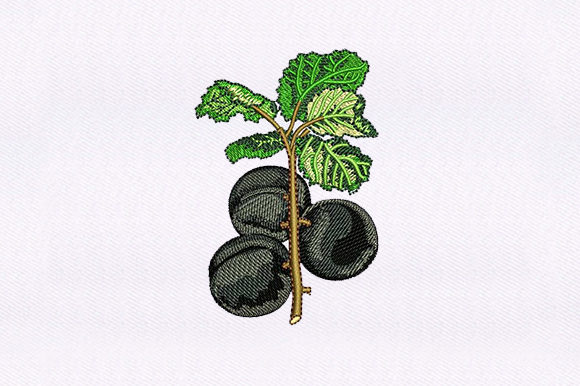
At first glance, Black Cherry Vines feels like a hand-drawn sketch translated into stitch—fluid, slightly asymmetrical, with looping stems, clustered berries, and delicate leaves that suggest movement rather than rigidity. It reads as food only through context: the deep purple-black cherries, the glossy sheen implied by satin stitch highlights, and the vine’s organic sprawl. But more than “fruit,” it reads as harvest, seasonality, and handmade care. That nuance matters—especially if you’re designing for a small shop selling kitchen towels, baby onesies, or holiday gift bundles.
I tested it on a linen-cotton tea towel first—the kind customers pay extra for because it feels substantial and ages beautifully. The vines wrapped naturally around the corner near the hem, and the berries held their shape without looking stiff or pixelated. No forced symmetry. No over-engineered density. Just confident, breathable embroidery.
Where Black Cherry Vines Shines (and Where It Asks for Thought)
This design excels in projects where subtlety builds value: custom apparel for boutique cafes, embroidered patches for slow-fashion brands, nursery decor that avoids cliché, and personalized gifts where the recipient feels seen—not marketed to. I recently used Black Cherry Vines on a heavyweight cotton tote for a local orchard’s pop-up shop. Stitched in charcoal grey thread on oat-colored canvas, it read as artisanal, not promotional. Customers asked about the maker—not the logo.
It also translates beautifully to baby embroidery. On a soft bamboo-blend onesie, the vine’s gentle curve follows the neckline without crowding, and the berry clusters are large enough to read clearly—even after three rounds of washing and tumble drying. No fraying, no puckering, no need for heavy cutaway stabilizer (a win for lightweight fabrics).
That said, Black Cherry Vines isn’t a one-size-fits-all embroidery file. Its charm lives in its detail—and detail demands respect. Avoid cramming it into a 3” hoop unless you’re willing to simplify or scale down manually. On stretchy fabric like jersey or thin knits, use tear-away + light cutaway stabilizer beneath, and reduce top tension slightly to keep those satin-stitched berries from pulling or gapping. On dark fabric, test your thread colors carefully: a matte navy or deep plum often reads richer than black, letting the vine’s form—not just contrast—carry the visual weight.
Design Integrity in Commercial & Handmade Contexts
For Etsy sellers and small shop owners, Black Cherry Vines is a quiet confidence-builder. It doesn’t rely on novelty—it relies on execution. That means your finished product says “I paid attention” before the customer even touches it. I’ve watched buyers linger longer on listings featuring this design in mockups—especially when styled with natural light, raw-edged seams, or unbleached cotton. It supports brand consistency without shouting over your voice.
It also performs well across digital touchpoints. As a printable mockup asset, it holds up in grayscale previews (critical for email thumbnails or Pinterest pins), and its clean line work scales smoothly for social media banners or product tags. As a digital embroidery file, it’s versatile—but don’t assume it’s license-free for resale. Always confirm usage rights before bundling it into craft kits, offering it as a bonus download, or listing it as part of a commercial embroidery service.
Practical Designer Notes Before You Stitch
- Test first—on scrap fabric matching your final project’s weight and weave. Linen? Knit? Terry cloth? Each reacts differently to the same fill stitch density.
- Check thread color contrast on both light and dark backgrounds—not just on screen. What looks rich on your monitor may disappear on indigo denim.
- Review stitch density in the berry clusters. If your machine hesitates or stitches feel stiff, consider reducing density by 5–10% in dense zones.
- Confirm hoop size compatibility before digitizing for caps or curved surfaces. Vines wrap well—but only if the design fits within the stable embroidery area.
- Inspect small details under magnification: leaf veins, stem taper, and berry highlights should read cleanly—not muddy or overfilled.
- Use proper stabilizer—especially for textured fabrics like terry or bouclé, where loose loops can catch in vine curves.
- Test washability on a sample piece. Does the satin stitch hold? Do leaves retain crisp edges? This matters for baby embroidery and kitchen textiles.
Final Thought: Why This Design Earns Repeat Use
Black Cherry Vines isn’t loud. It doesn’t chase trends. But it delivers something rarer in the embroidery space: reliability with character. It’s the kind of design I reach for when a client says, “Make it feel special—but not fussy.” Whether it’s stitched on a wedding guest book cover, a chef’s apron, a holiday ornament, or a limited-run sweatshirt for a farmers’ market vendor, it grounds the piece in authenticity.
For craft business owners, it’s a low-risk, high-return addition to your design assets—especially if you serve food-adjacent niches (bakeries, preserves brands, farm stays) without wanting to lean into cartoonish fruit graphics. For hobbyists and makers, it’s a satisfying project that teaches restraint, rhythm, and how negative space can be just as expressive as stitch.
In short: Black Cherry Vines earns its place not because it’s perfect—but because it’s thoughtfully made, quietly versatile, and ready to become part of something real.